Q:
I want to convert my Beta tapes over to DVD and would like to know which Beta machine you would recommend I buy, since mine has died?
(Q#1)
A: A lot depends on how important your tapes are to you, how they were recorded, and
how much money you are willing to invest in your project. If you have tapes that
were recorded through the years using Beta
machines with different format types (example: regular Beta, SuperBeta, BetaHi-Fi, Betamovie, etc.) consider
choosing a SuperBetaHi-Fi model, because it will be capable of playing
all the speed and sound variations that were introduced over the years. Another advantage is you will gain the more refined picture circuitry found in the later design machine.
It will make your older tapes play better and look better. This does require
a slightly larger investment than purchasing a standard beta machine. But If you weigh the investment
of your time and the personal value of your tapes, the cost of the player really becomes
secondary. To examine a Beta format playback compatibility chart click here.
But whatever you decide to purchase DO NOT destroy your old Beta tapes after your done
and keep the machine you used for playback. Why? Because the magnetic tape inside those cassettes has a
proven shelf life of many decades. Recordable DVDs and CDs are now being
found to start degrading after just a few years. Ouch! What's that again? Check
out these related articles before you invest countless hours transferring your
precious video tapes to DVD, click here.
Q: I have some beta cassettes that have tape inside that is
broken and they are very important to me. Is it okay to splice them? (Q#2)
A: Splicing video tape is not recommended. It's nearly impossible to get the two tape ends mated perfectly and the impact of the video heads hitting a space or overlap
could cause them damage. Just as bad would be the splicing tape adhesive squeezing out
into the mechanism and messing things up inside the VCR. The answer to your
dilemma would be to have the tapes loaded into separate cassettes so they can
be played individually with no risk of damage to your machine. A duplicating facility should be able to perform this service for you. If you are unable
to locate one, contact me regarding your
particular need.
Q:
I looked inside my Betamax and it looks like some of the electronics are missing
on the printed circuit boards, why are these areas empty? (Q#3)
A: When the designers traced out the original circuitry they allowed for the
boards to be used for several machine models. This was a cost saving measure
and in no way detracts from your unit. Also upgrades and production changes
will sometimes allow for components to be deleted without any loss in performance
or quality. On the other hand additional electronics are sometimes added onto
boards, these can be piggy-backed onto transistors, ICs and other components.
Sometimes small circuit boards are even stuck in places onto a main board.
Q:
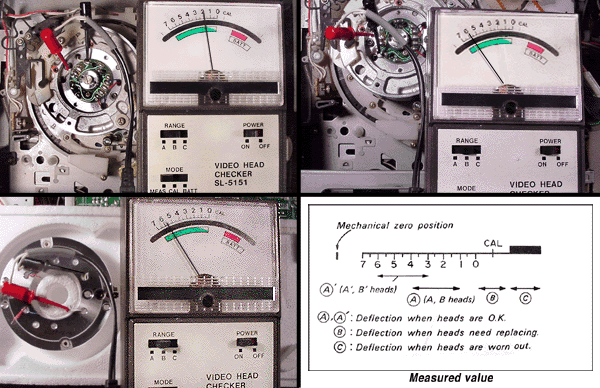
I have white specks showing up in my playback picture, are my heads wearing
out and how do I tell when they are going bad? (Q#4)
A: If adjusting the tracking, using a good grade of cleaning tape or having the
machine professionally cleaned will not remove the specks from the picture then the heads will need
replacing. Identifying video heads that are wearing out requires some detective work, but before getting into how to do this
let me clear up what I mean by a "good" cleaning tape. The only cleaning
tapes I can recommend are the ones of the high lubricant variety, such as those marketed by Sony or 3M. These are getting harder to find now in Beta but they are the
only ones that are truly friendly to your machine. The type with the special paper or dense cloth that you wet would be a second choice, but only if you are unable to
find the other. The loosely-woven cloth wet systems should never be used because they
can damage the heads in your machine. Keeping this in mind, I can not express enough how important it is to have your precious Beta
professionally serviced. This is the only true way to maintain the picture quality
and operating functionality that the unit is capable of producing. If no technicians
in your area can do this then contact me about doing it for you. Now
about how to tell if the heads are wearing out. Video heads that are going bad
will start to produce small specks of white (and black) that show up mostly to
the right of picture items that vary greatly from dark to light and vice-versa. As
the heads degrade the bugs will start to have comet tails and will eventually
increase into lines. Heads that are wearing out also seem to get dirty more often and require
more cleaning. The DA4 video heads
(found in the higher end SL-HF750, SL-HF900 etc.) seem to have more of a problem
with plugging (oxide building up around the head gap) than the simpler two head varieties. Once the heads start to go bad, replacement is the only correction. To see more on how to tell if video heads are going bad, check out
the "Beta Refurbishing" section and the page on video head evaluation, to go to that page click
click here
Q:
How can you tell if video tape is wearing out? (Q#5)
A: Video tape can wear out in a variety of ways but by far the most noticeable
is the increase in dropouts. These will appear in the playback of a recorded
picture. Not to be confused with the video heads wearing out as in the question
above, dropouts are random and come in both white or black varieties. The toughest
quality test for a tape to pass, and one of the best ways to see how well a
tape can reproduce an image, is to record what is called a blank raster (a black
video signal). Dropouts will be seen as streaks, black spots, lines or specks
every time a oversized lump of oxide or a missing magnetic particles is traced
over by the video heads. If your playing back a failing prerecorded tape (repeatedly)
the image will become noticeably grainy and coarser as the tape starts to degrade.
This is because it is losing oxide, the recorded picture is actually falling
off the tape. Dropouts show up in these tapes even though the image is already
there, but it shows up more when making recordings. One side note, your video
recorder has special circuitry to detect and mask over a certain amount of dropouts.
Some units are even capable of inserting a previous scan line to replace one
that has disappeared due to a large loss of video information.
Q:
How long do tapes usually last? (Q#6)
A: Video tapes last a very long time but will last even longer if stored in a cool
dry place free from static electricity and stray magnetic fields. And it does
not seem to matter too much whether you store them vertical or horizontal but
I prefer the vertical. The storage systems once market by Sony, the VK series,
had them placed vertical and it seems that I read somewhere that this is the
preferred way. How long is lasting a long time? I have tapes made from my SL-7200
of twenty-five plus years ago that still play quit well, and that is a pretty
long time.
Q:
Who makes (made) the best video recording tapes? (Q#7)
A: Almost every recognizable name brand makes (made) pretty decent video tape,
but if you put my feet to the fire I would record my most sacred recordings
on Fuji, 3M (whom no longer makes consumer video tape), Maxell, TDK or the house
brand, CopyRight. Please keep in mind that this is only an opinion. I do recommend
spending the extra pennies for the high grade varieties, if you can get them.
They usually produce a better picture and, in my opinion, that's what video
recording is all about. One more thing don't buy bargain brands, they are not
worth the savings. Why risk messing up your priceless Beta when the cost of
getting it back into shape is so high....do not do it!
Q:
How often should video heads be demagnetized? (Q#8)
A: Sony recommends it every 500 hours under their service recommendation: Cleaning
and Degaussing. They explain it: "If the video heads should become magnetized,
the signal-to-noise ratio deteriorates and slant beat patterns and noise will
appear in the picture." They suggest it be done to the audio, control and erase
heads in addition to the video. What it does is scatter or demagnetizes the
microscopic particles in the flux producing media (or cores) of the various
heads. The media in this case is the laminated, pressed or composite material
used in their manufacture. The cores produce the magnetic fields necessary for
recording in response to electrical impulses passing through wires that are
wound around them. The opposite occurs for playback. The magnetic information on the tape excites the core creating an electrical signal in the wire winding that the electronics turns into a picture or sound. The degaussing procedure should only be done by a professional
because it requires special equipment and a special method. Too strong a degaussing
field or an accidental impact can shatter the delicate video heads.
Q:
What is the best recording speed for the best overall picture quality? (Q#9)
A: The fastest speed with the widest video heads will render the cleanest picture.
This would make the SLO-383 (or any dedicated Bx1 recorder) the unit of choice
for video signal strength alone. (There are other considerations such as SuperBeta,
Hi-Band and ED Beta.) If you want a Hi-Fi unit then the choice would be machines
that have the capability to record Super Hi-band BIs such as the SL-HF1000,
SL-HF750, SL-HF2100, SL-HF900 (modified), etc. From a subjective standpoint,
keeping in mind the size of the recording heads involved, it seems that the
best overall speed is the BII mode. It still produces a slight guard band on
the tape and the (SuperBeta) picture is almost as good as recordings made in
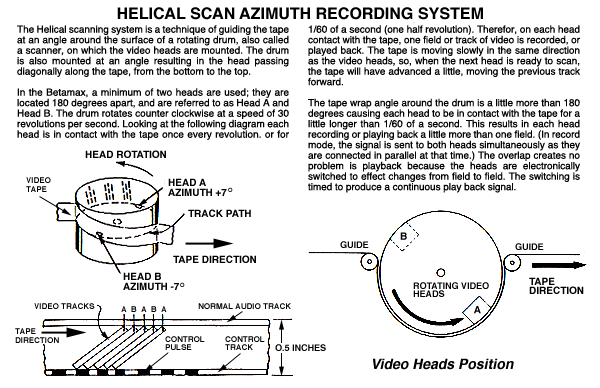
BIs. Note: a guard band is an area of unrecorded tape between the tracks that
acts as a barrier to help prevent unwanted cross talk from occurring. For more
information see azimuth recording in the "Beta Refurbishing" section or
click here
Q:
My Betamax shuts down after a few seconds of playing and then only the
eject or power switches will work, what is wrong? (Q#10)
A: Most newer Beta VCRs are programmed to shut down if they detect the take-up
reel is not rotating. Something is stopping the forward movement of the tape
in the machine and it will require a professional repair.
Q.
My Sony SL-2305 will accept a tape but plays for a few seconds then stops. When
I eject the tape a length of tape is hanging out of the cassette. What can be
done to fix this? (Q#11)
A. There can be several causes for this type of problem (see question above)
but for this model the most likely cause is a bad pendulum arm assembly. Sony
used a design for a short time that leached adhesive and stuck up the drive
gear preventing its rotation. The only fix for this is a replacement.
Q:
How many manufacturers made beta Machines? (Q#12)
A: Here they are the actual manufacturers in no particular order: Sony, Sanyo Toshiba, NEC and Aiwa.
Brand names that appeared on Beta machines:
Zenith, Sears, Realistic, Pioneer, Marantz, Murphy, Magnasonic, International
Rent-A-Beta, Navco and I. Arthur Rank. I have a cassette tape box that also lists two other
brand names, Wards and Hitachi, although I have never actually seen a machine. (For more info click on the "The Betamakers" link at right or click here.)
Q:
My picture blanks out and the sound goes in and out during playback, what's
wrong with my machine? (Q#13)
A: If the problem happens with various tapes then it is probably the ACE head
assembly. (An acronym for Audio, Control and Erase.) It has the responsibility
of producing the synchronized start of the picture by recording and sensing
(in playback) a control pulse on the video tape. This pulse tells the video
circuits how to regulate drum servo to match the two fields of the playback
picture. This signal is different from one sometimes seen at the bottom middle
of the picture as a white bug running back and forth. This burst is the head
switching signal that fires off each frame, two per second. If the ACE is worn
it cannot make good contact with the tape and the pulse signal is lost causing
a no picture condition. Repairing this malfunction will require a professional
replacement. But before you take it to the shop check this if you have a cassette(s)
that seems more prone than others to problems. Flip open the access door and
examine the tape. Do it by pressing the small lever lock inside the little square
hole on the cassette door. Check and see if there is any wrinkling along the
bottom edge. If there is this can produce poor stability and may indicate something
inside the unit is running out of line causing damage to the tape as it travels
through the machine. Still a service job but you'll know not to risk anymore
of your tapes by using this unit.
Q:
My EDV-9500 Beta machine seems to have a lot of white specks in the picture,
what causes this? (Q#14)
A: The first suspect is the video heads. Try using a good quality cleaning cassette
(see question on these further down this page). If this doesn't work and you
have another machine make some recordings on both then observe and compare the
two. Through the process of elimination you may be able to draw some conclusions
about the heads, they may be defective. (To find out more on video head evaluation
click here.)
Replacement would require a professional repair. There could be another culprit.
Assuming that the heads are good and the color noise or confetti is mostly in
the black areas of a good recorded signal, then this could be caused by bad
capacitors in the color circuitry. The offending capacitors would need to be
replaced, this too is a job for the service professional.
Q:
My SL-HF2100 displays vertical black and white bars when first playing a picture
then is ok once the picture comes on, sometimes this may take several seconds
to clear up, what is happening to cause this? (Q#15)
A: A capacitor in the video head amplifier circuit is failing and causing a delay in the signal
from the video heads. When this is happens the SL-HF2100 video circuits have nothing
to work with for a playback signal until the faulty capacitor reaches full charge and the digital bars are the result. This
will require professional repair.
Q:
The picture is unstable on my beta and it seems to tear off and on in the middle,
what is the cause? (Q#16)
A: Most likely cause is the video drum servo control circuit, it is unable to
hold a stable speed. The is a repair problem.
Q:
Why does sound on my VCR go up and down in pitch, also the tracking has no effect
on it? (Q#17)
A: The problem is like the one above only this time the capstan servo circuit
is the one giving the problem. This too is a repair service problem.
Q:
My machine lights up and the clock works but none of the buttons do anything,
what is the problem? (Q#18)
A: The most likely problem is in the power section of the unit or in the system
control circuits. This is a problem requiring professional repair.
Q:
Why did Sony not produce a 25th anniversary Betamax? (Q#19)
A: My best guess would be that they felt there just would not be enough demand
to justify putting out the effort. I find this especially sorrowful knowing
as I do that with the digital to analog technology available from Sony, any
product on the par with the SL-HF2100 or ED Beta could be outstanding.
Q:
Why did Sony stop making machines, were they not aware of the prices that their
old machines are commanding on ebay and other auction sites? (Q#20)
A: My best guess is they know the prices their past Betas are auctioning for,
but are unmoved. For a large corporation like Sony to reproduce something for
a small niche market just doesn't add up to them, dollar-wise. Beta has always
been, and still is, the best medium for serious people who want to record, edit
and preserve video. ED Beta was unsurpassed for home video picture quality. S-VHS, DVD,
or laser couldn't top it. Only digital, HDTV or line interlacing could compete.
Sony could make more machines, of course, but that would take an act of God.
Q:
Why did Beta get beat out by VHS? (Q#21)
A: Looking back on the past reveals a lot of variables that could account for
the struggles Sony had with Beta in the marketplace. In some ways they were
there own worst enemy. Their system was without a doubt the better of the two
but Sony just couldn't convince the masses that it was worth the price differential.
To make matters worse they made the tape length numbering (recording time) system
hard to decipher. The average consumer wasn't interested in trying to figure
out what L-500 or L-750 meant at what speed. VHS kept it simple with a 2-4-6
hour recording scheme that buyers could easily understand. Another stumble was
the BII only SL-8600 machine. Some BI people saw it as Sony turning
their back on them, when really it was an attempt to produce a cost effective
answer to pressures from lower priced VHS machines. Sony didn't have a crystal
ball and they knew they had the best format if they could just get that across to the
public. They had built their company on innovation, creativity and quality, and
they were fighting to protect their reputation. It's not easy being a large
company trying to always stay on top. The competition is always there looking for a
nick in your armor, so they can eat into your market share and expand theirs. To their credit Sony stuck with
Beta for a long time, a decision that could have killed a lesser company.
Over this period some great products and creative technological ideas were born.
Q:
The tape goes into my machine but then comes right back out, why? (Q#22)
A: Something is wrong with the threading or loading operation of the machine and professional
repair is required.
Q:
My cassette goes into my unit but gets cocked, is something broken? (Q#23)
A: If the cassette jams and gets cocked going in then the loading assembly is
defective and repair is needed.
Q:
After a few seconds my tape stops rewinding then I have to eject my tape and
try again, sometimes it takes several tries before a tape gets fully rewound,
what can I do to correct this? (Q#24)
A: Most likely the video drum has become polished and more drag is being produced
during rewind on the tape than the motor can overcome, causing the unit to shut
down. The motor could also be getting weak or the unit may need lubrication.
This is a service problem. Also now would be as good a time as any for me to
harp on not rewinding tapes in a Beta machine. It's true all machines are capable
of rewinding, but do not do it (particularly with the Sony units). What it does
is polish the surface of the video drum and make it difficult for the machine
to maintain proper operation due to the excessive drag that results. Buy a rewinder,
preferably one that does not use the stop-and-pop method to stop, this can cause
fish-eyes and breaks in the tapes. I offer a good one and I recommend it highly.
Q:
With good Betas getting harder to find as each day passes, what is the best way to prolong
the life of my machine(s)? (Q#25)
A: First heed the dialog above about rewinding. Buy a tape rewinder or a Sanyo
unit that threads the tape back into the cassette for winding and don't rewind
tapes in the unit your wanting to conserve. Then baby it, and use only the best
tape money can buy. Give it plenty of ventilation and keep it out of dusty,
dirty or smoky atmospheres (cigarette smoke over time will ruin your Beta).
Get it serviced every 500 hours like Sony recommended and when something goes
wrong get it fixed by someone familiar with the particular needs of the Beta
format.
Q:
Can I still buy a new Sony Betamax? (Q#26)
A: Sorry, no new Betas. Sources other than new are: me, ebay and private sales.
Q:
How do cleaning cassettes work and which ones are the best? (Q#27)
A: Several types of cleaners are popular. My favorite is the heavy lubricant
variety developed by 3M. As you probably know all good brands of video tape
have a very light lubricant coating on their oxide surface to help reduce head
wear and improve tracking characteristics. What 3M did was discover that a extra
heavy coating of lubricant could roll off deposits and oxide build-up while
being friendly to the surfaces it was coming in contact with. They also found
that so much lube lifted the recording surface from the heads and made poor
recordings, not too much of a concern though when the idea turns out to be a
cleaning tape. They got a patent for their process and their product is marketed
as the Scotch brand. Several other companies buy their tape, load it and sell
it under their own brand names or license the process for their own manufacture.
Sony and CopyRight are of this type and are highly recommended for periodic
use. Of coarse cleaning bad video heads won't make them any better so if the
cleaning tape doesn't correct a poor picture problem then video head replacement
may be needed. My least favorite, which you shouldn't find anymore, was the
loosely woven cloth type that used a solvent. Here you would wet the fabric
tape which was then loaded into the machine to clean the heads, etc. Bad because
the fabric could flake off and pile up on the heads requiring service or repair
to correct. There is a wet cloth variety that is better, It has a special, tightly
woven cloth tape that is less likely to shed while delivering the cleaning solution
to areas inside the machine. I've observed these as they operate and they seem
to do a decent job, but I recommend using caution and not overdoing it. Another
kind of cleaner to avoid, which I don't think you can even buy any more, is
the sandpaper type that used a rough surface tape to actually buff the video
heads to remove build-up. These were brutal on the heads. They were also hard
to distinguish from the lubricant tape types so know what your buying. The reality
of it is nothing beats professional cleaning.
Q:
Did any manufacturer other than Sony offer a consumer Betamax with BIs recording
capability? (Q#28)
A: NEC offered a very nice four head model, the VC-N65EU which recorded and
played BI, BII and BIII. It was also a SuperBetaHi-Fi unit.
Q.
My machine is producing a white line like a pulse every few seconds in the picture.
What is causing this? (Q#29)
A. Assuming it is one of the later design units, this can be caused by faulty
capacitors that are not doing their job in the capstan circuit. They are there
to absorb the burst or spike of electricity produced when the switching of the motor coils occurs, which produces
the rotation of the capstan motor. They leak and can cause a mess that will
require replacement and cleaning, something requiring a technician.
Q.
The capstan seems to be running too fast and in reverse in my unit. Why is this
happening? (Q#30)
A. The most likely cause is the capacitors have leaked and caused corrosion damage to the printed traces on the circuit board underneath. Loss of the electrical continuity then produces faulty running characteristics. It is can also be due to a defective capstan IC, hall sensor or other component. This is a professional repair.
Q.
How would you rank the quality of the VCRs from the different Beta manufacturers.
(Q#31)
A. This is a tough question to answer because there are so many variables. Overall
I would have to give Sony the highest marks, as you would expect because it
was their baby and they did most of the innovating. They lead the field for
creativity and made some very nice machines that are still in great demand today.
The others were not exactly slackers either. Sanyo machines are easy to work
on and very durable, they have some good technology too. The same can be said
for Toshiba. Aiwa only produced two entries, but they were very creative and the
units were full featured. NEC produced several strong models with lots of appeal.
Now that one can look back and closely examine the big picture you are struck
with one sad fact. Had the format continued to have a strong following, given
today's digital technology and the creative edge of the companies that were
in the forefront, Beta may have......oh well, enough of that.
Q.
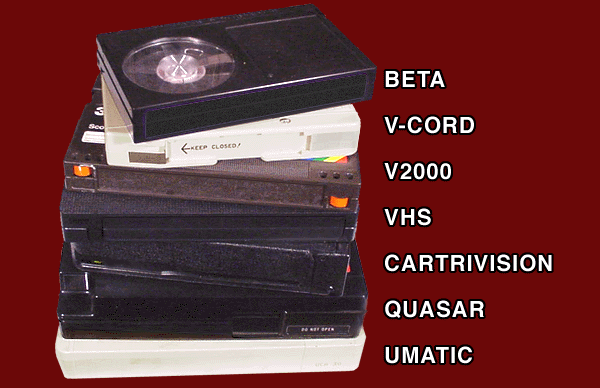
How many different competing formats were there when Sony introduced the first
Betamax and what did their cassettes look like? (Q#32)
A. The major formats in the beginning were from Sanyo, Quasar and Cartrivision.
There was also a PAL system from Phillips Electronics introduced in Europe.
The Cartrivision was the first to introduce a movie rental system. More information
on these units can be found on the web but you won't see much on the how their
cassettes were designed and how they worked. If your interested you can click
here
to learn more
Q.
How many different cassette changers did Sony make and did VHS have any? (Q#33)
A. I am not aware of any VHS changers. There attitude must of been why get involved
when the public was already sold on their product just the way it was. Sony
felt if the issue was total recording time, then let's give them what they want.
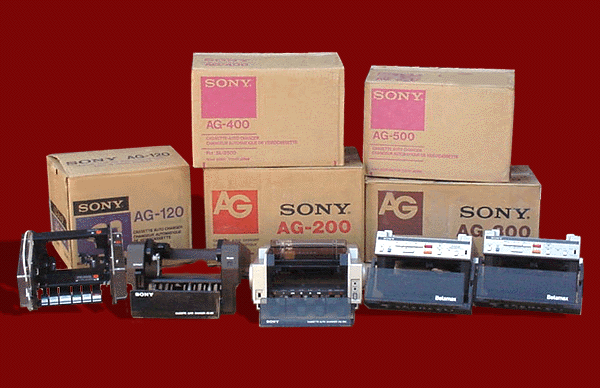
You could record up to twenty-four hours with one of these babies using four
six hour tapes. There were five models produced for the US market before Sony
decided to abandon the project. They were: the test marketed AG-120, then the AG-200,
AG-300, AG-400 and the AG-500. They were all very interesting and it was a marvel
to watch them perform. You can see each of the models, information about how
they worked and which changers went to which model by clicking here
Also see question further down.
Q.
Why didn't the first BetaHiFi units receive stereo? (Q#34)
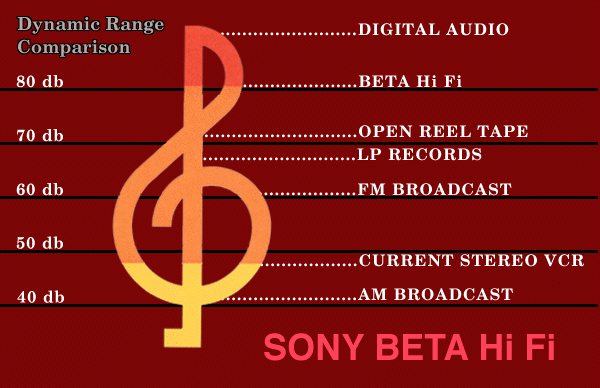
A. When Sony developed their system for combining the audio and the video signal
(BetaHiFi) a state side standard for stereo television broadcasting had not
been decided. In order to increase the desirability of their new BetaHiFi stereo
recorders and to present them to the public as designed to be upgraded, they
made them with MPX adapter plugs on the rear panel. Sony and other manufacturers
would later make stand alone stereo receivers and amplifier units to interface
with these machines. Several later models were made that were "HiFi ready" and
had a multi-pin receptacle in the back. These would interface with a multiplex
unit and would turn them into a BetaHiFi stereo VCRs. Only Sony made their adapters.
To learn more about the adapters and to see the various models click here
Q:
The tracking control on my beta seems to have no effect, what gives? (Q#35)
A: The most likely cause is the variable resistor (potentiometer) is bad that
regulates the voltage to the tracking circuit. The circuit itself could be faulty
and not allowing the tracking adjustment to have effect. It needs professional
repair.
Q:
I have a EDC-55 ED cam that powers up but won't get a picture because the lens
closes down. What is causing this? (Q#36)
A: The most likely cause is a faulty DC-DC converter in the camera head. I have
found that the capacitors fail and consequently the required voltages needed
to power various functions within the camera are lost. This results in faulty
operation and the auto exposure circuit is sometimes effected. This can also
result in no picture. It gets worse. Leaking capacitors on the boards in the
camera can eat away the printed traces and cause all kinds of problems. I know
this sounds funny but closely smell different areas where there are openings
to the inside out the unit. See if you can pick up a acrid odor (it smells like
vinegar mixed with salt) it is an indication that bad things are happening inside. To restore proper operation requires that the capacitors be removed, the boards cleaned of all traces of leaked fluid and the caps replaced. This requires a professional
repair and it can be very costly, depending on the extent and nature of the repair. To see how this this camcorder is refurbished
click here
Q:
Why do some machines produce lines (noise) in pause and others do not? (Q#37)
A: Noise in pause is present because information needed in that spot is not
being picked up by the spinning video heads. When the information was recorded
on the tape it was traveling around the video drum, this stretched out signal in comparison to the now stationary
tape in pause. That is, the heads that wrote the information are tracing at the same
size as the drum but the paused recorded signal is longer due to it's movement when being recorded.
Higher end machines use extra heads or digital effects to clean up the picture
by filling in the lost information with a second reading or pulling up information
from memory of the last clear picture. (To learn more about this see the question
below.)
Q:
I have a GCS-50 and a switch on the front indicates it is for a framing servo. What is it and what it is used for? (Q#38)
A: The framing servo switch is used for more accurate editing. With a name like
servo you would think this is a motor but since it refers to circuitry within
the machine that controls a motor, it takes on that identity. Here is what it
does. When you pause a Beta machine with still picture capability the capstan
will stop at random, which produces noise bars somewhere in the picture (see
the question above for information on this). The location will change with each
subsequent pause because the frame is not precisely lining up to exact start the picture
in the right spot (frame) each time. Also noise is created
because the long skinny magnetic signal placed on the tape when the picture
was recorded is stationary and now doesn't line up correctly with the path of
the spinning video heads. (The path was recorded as the tape was moving which
spread it out, when the tape is stopped most of the signal can be picked up
but some is missed because the video heads cannot swipe all the signal from
start to end.) Now to get around all this and produce a clear pause picture
involves several methods. One is to provide a couple of extra video heads
to double trace the same signal and fill in the missing information. (This is
one of the reasons the still picture is not as sharp as the moving one because
only one half of the thirty frames per second is being looked at.) Another is
to align the tape exactly at the start of the frame of the picture so it can
start at the top like it should. This method still requires at least one extra
head to fill in information not picked up. These units actually move the capstan
ever so slightly after pause is initiated to line up the picture. That is to
say they frame the still picture. The SL-HF500 and SL-HF600 are examples of
machines that do this and it is done by sensing the pulses on the control track
and stopping the tape at just the right point. You can hear these units operating
a special head switching relay as they perform this function and watch as it
produces a clear still picture on the screen. Here we see the framing taking
place as it relates to the servo (capstan motor) being controlled. If you add
another video head (two for recording and two for still) you get the best of
both worlds, this is how the GCS-50 produces a rock-steady still picture. Turning on the framing servo switch for editing insures
(as much as possible) that the edits being made will take place on the frame
increments, which is very accurate. You see the actual edit frame as presented
and lined up. By the way the GCS-50 doesn't have to have the relay mentioned
earlier because it has two heads creating the clear still picture (or more correctly,
two dual azimuth heads, for a total of four). The tape therefore doesn't need
to be moved (but very little) to produce still frame alignment, it is done
when the capstan comes to a stop. Pretty clever. Check out the GCS-50
and the SLO-383 in the VCRs section for the application of the framing servo mode.
Q:
I watch my Beta recordings on a big screen TV and I notice some kind of noise
that appears as a vertical bar in playback. I notice mostly where the screen
is almost black. I can move it from left to right with tracking but it will
not go away. Knocking the tracking way off makes it get worse. It isn't noticeable
from a distance but I know it's there and I wonder why and how to get rid of
it? (Q#39)
A: What your describing sounds like a very slight wrinkle in the tape path envelope
or the interference bar seen in many Beta II recordings. One of the difficult
things to do in the Beta format is get the tape path perfectly flat. The tape
travels through the machine with very little tension and isn't stretched over
the drum as with the other format. This characteristic demands that extra pains
be taken during path alignment to produce the "ideal" flat envelope. The bar
becomes noticeable if the tape isn't completely flat or when wear causes cupped
areas at the pockets where the hold down fingers are stationed on the drum.
Try using a thinner tape, such as is used in the L-830 cassettes, and see if
it goes away or lessens. If it does this will may verify that it is being caused
by the path alignment or wear (thinner tape flattens out easier due to the softer
nature of the tape). The remedy would then would be a tape path alignment and/or
upper drum replacement. If the bar is only seen in Beta II and isn't improved
by a thinner tape, then what you are probably seeing is the noise bar common
to most Beta II recordings. This slight wavy vertical bar pattern is caused
by an electronic beat introduced by the electronics when it down converts the
signal during processing. This is the nature of the format and can't be adjusted
out.
Q:
I recently purchased a SL-HF860D Beta VCR off of Ebay and it doesn't power up
completely. The display comes on but the power light and function buttons don't
work. Also, is there any way to avoid getting a unit that doesn't work correctly
from an auction? What questions should one ask before placing a bid? (Q#40)
A: Okay we will examine the VCR problem first, then I will give some thoughts
on Ebay auctions. The most likely cause of the problem your describing for that
model would be in the power section. The DC-DC converter has failed or possibly
a switching transistor is bad. This is a professional repair. About Ebay. It
is an auction and like all auctions it will always involve some risk. Ebay can
try but they can never eliminate the uncertainty of bidding from a photo and
description. You are bidding on something that is going to be sold to the highest
bidder. You have seen the many times that items are offered "as is" and that
is to indicate that the seller is offering no assurances as to the items operation
or condition and accepts no responsibility for it. I have won many things from
Ebay auctions over the years and I am pleased most of the time. Many items just
would not be available to me any other way. But worse than the risk of the unit
being misrepresented is the packaging and shipping issue. I have received numerous
items that must have been nice when they were shipped but arrived destroyed
due to poor packaging. (See my section on proper packaging.) If you purchase
something that must travel by freight, do what you can to impress upon the shipper
that the people that will be handling your goods en route simply cannot be expected
to handle it with kid gloves, not in the real world. Ebay receives high marks
in my books for making such a varied and versatile array of items available
to a wide audience. I know of no questions you could ask a seller that would
render any guarantee that could be trusted completely. Feedback is a fairly
good barometer except many sellers wait for their buyers response before posting
one of their own. This practice pollutes the data somewhat and could easily
be corrected with a data blocking system for both parties. Ebay does a reasonable
job of policing it's wrongdoers, which is small comfort if you end up with an
item that was misrepresented. I see warranty offers now and some other things
coming in the future, but for now Ebay auctions involves taking on some risk.
It is, after all..an auction.
Q:
I would like to buy a changer to fit my SL-2700. Which one should I buy? (Q#41)
A: The SL-2700 would require a AG-500, and it is quite rare. I offer them from
time to time, you can check their availability by visiting the Accessories section
of this Site. The AG-400 can be used also, but you will have to work around the
attaching plate incompatibility problem. Which prompts me to say that when you
acquire one of these changers be sure to get the attaching hardware. They aren't
much good if you can't mount them on the machine. Here's a run down of which
changers fit what machines. The SL-7200A, LV-1901A and SL-8200 can use the AG-120
or the AG-200. The AG-200 can also be used on the SL-8600. The model AG-300 is for
the SL-5400, SL-5600 and SL-5800. The SL-2500 and SLO-420 uses the AG-400. The
AG-500 is used for the SL-2410, SL-2415, SL-2700 and SL-2710. For further information
on changers click here.
Q:
The display in my SL-HF900 is getting dim. What can be done to correct this?
(Q#42)
A: Two things will most likely cause this problem, a failing power supply or
a failing display tube. In the SL-HF900 it seems to be more common for the power
supply to be the cause, which is good because the tubes are no longer available
new. Usually a transistor or zener diode begins to lose it's value and the display
continues to get dimmer as the part(s) travel down the road to failure. Tubes
can get dim because they gas off, which is the loss of the gas that carries
the electrons to the phosphors printed on the back plate in the display. Fewer
electrons being able to hit the material means fewer atoms will fluoresce and
the characters shine less brightly. Either way this is a professional repair.
If the tube is bad a replacement would have to come from a parts machine. That
would be hard to find because SL-HF900s are usually too valuable to part out.
Q.
I have heard that some Beta units can be used to produce animated sequences.
Which ones and how is it done? (Q#43)
A. It is true that some models, by repeatedly pushing
the pause button while the machine is in the record mode, will record one frame advanced
at a time. The SL-HF900 will do this and so will many of the late model high
end machines. If you attached a camera or use a still frame source such as a
computer, spot generator, etc. and move the subject slightly each time you pushed
pause, the recorded video would play back as animation. I tried it with the
SL-HF900 and it worked well, but was very time consuming. This particular event
occurs because that high end units during pausing in record wind back the tape a few frames each time,
this is to find and align with the the last recorded control pulse. This action, called mirco-timing phase alignment, helps
the recorded segments line up better and produces edits between scenes that
are smoother. Each time you press pause during an animation session the roll
back advances one frame due to an overlap produced as it searches for the next
pulse. This actually is good information to keep in mind should you want clean
edits between scenes, keep your fingers off the pause button between edits or
you could mistakenly add a frame you didn't want. If you should inadvertently
press pause twice, then to get a clean edit would require that the edit points
be lined up again. To do this you would have to stop the tape, rewind, play
and then pause again at the location you wanted as your edit point. This animation
"feature" was not a built-in design function but an anomaly produced by
the micro-timing phase process when using this step-by-step recording. If you want
to know more about true pre-roll editing, that is when both machines switch
at predetermined edit points while the tape is moving, check out the SL-HF1000,
GCS-50 or the SLO-383 in the VCR section.
Q:
My SL-HF360 locks up sometimes when I try to program the timer after inserting
a tape. I then have to unplug it and reset everything, how can this be fixed?
(Q#44)
A: I've got good news and bad news. The bad news is that this is a flaw in the
system control IC programming that slipped by the designers at Sony. It seems
that if you time it just right and press the timer programming button just after
a tape loads, the unit resets and then locks up. Not one button will function..nada,
the only option is to unplug the machine and start over. The good news is that
the SL-HF360 is a great low end unit that will give you great performance without
complaint as long as you give it a second or two after the tape loads before
pressing the timer setup button. So this is a glitch and there is no fix.
Q:
I am going overseas, can I take my Beta with me? If not, how do I best store
it? (Q#45)
A: Using your Beta in another country involves several things. First is the
power supply consideration. Check the household current standard for your country
of destination and purchase a converter that alters it to match your unit. Next,
you may want to consider taking along a television and some prerecorded tapes,
because the broadcast standard may be different. For a list of the different
standards click here.
Storing your Beta for safekeeping I recommend
using the original box, if unavailable then use one that will allow you to stuff
about two inches of padding all around your machine (see my section "PACKING"
below for more information). Enclose the manual and the remote without the batteries.
Doing it this way will keep everything together when you come back and want
to use it again. Store it in a cool, dry place and if you can find some desiccant
packages, toss several of those into the box as well.
Q:
Which Beta unit is the most difficult to repair? (Q#46)
A: The question has several answers. The SL-7200A, SL-8200 and LV-1901A
would qualify as the most awkward to work on because of their weight and size.
The most mechanically challenging units are the SL-5400, SL-5600 and SL-5800.
The most intricate are the Betamovies and combo units. The most technically
difficult and electronically sensitive is the EDV-9500. The most complicated
are the SL-2500, SLO-420 and SL-2700. The most difficult type of repair is an
intermittent problem that doesn't show itself until after a unit has been operated
for several hours and then doesn't show up again until more time has passed.
None are easy when they won't behave.
Q:
I recently arranged my cables that were laying all over the place behind
my component cabinet into tubular casings. Now I'm getting noticeable bars that
keep running across my screen at different times. I've tried rearranging my
cables but it doesn't help. It doesn't do it all the time. Is this a ground
problem? What can I do to get them out? I have several Betas and a switcher
going into my television. (Q#47)
A: Even though it seemed the right thing to do, putting all your cables in those
nice tubular casing can create picture problems. It's called "harmonic
beat" and it is created by sympathetic interference generated when cables
lay side-by-side. They act something like a transformer and pass electrical
current to one another causing surges at various peak levels in the video signal.
(It seems to effect the video more so than the audio, but in audio circles it
is called hum.) The problem is multiplied by having several pieces of equipment
operating at the same time. The best answer is to take the cables out of the
casings and lay the video lines at right angles to each other creating a totally
random path for the signals to travel. Now for the practical answer, move the
video cables for each item as far apart as feasible and when they intersect
try to have them at right angles to each other. Most sets don't offer a ground
anymore but you can buy a AC line filter. It smoothes out the house current and
cuts down on any spurious stray signals that may be being generated in your
area. This helps if you have someone in your area that is using any type of
equipment that creates line noise, such as a welder. If nothing works, you may
be located too close to a power station or high tension line (I wanted to cover
as many bases as possible) but I doubt this since it wasn't happening before.
In this last case you'd have to move.
Q:
I recently purchased a Sony SL-HF450 off of ebay and it has a computer type
nine pin plug in the back, what is this for? (Q#48)
A: The most likely purpose of the plug was to hard wire remote operation of
the unit. Some duplication labs or recording facilities elected to modify consumer
Beta units to fit special needs, or just to save money by avoiding the purchase
of higher priced professional machine. It made good economic sense if their
requirements didn't dictate the need for a more rugged pro machine. The plug
will probably not be an issue and the machine will operate normally. If it turns
out that some function is missing because the circuitry is expecting a connection
that isn't being made when using the plug, then it would have to be re-wired. This
would be a professional repair.
Q:
A friend of mine says that he used to service music jukeboxes that had Sony VCRs
in them and played music videos, have you ever heard of such a thing? (Q#49)
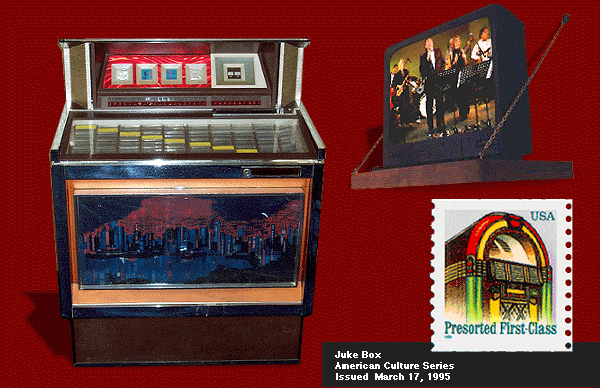
A: What your friend is referring to is the Video Jukeboxes that appeared in the late eighties. Manufactured by Rowe/AMI Corporation these units
had a SL-2000, SL-2005 or (later on) a BetaHiFi unit mounted in them that played
a video of the artist on a television screen as the music was playing. It was
possible to select the different songs because Rowe wrote programming for their controls that took
advantage of the Beta machines linear tape counters, which made the jukebox
capable of finding the different selections on the video tape. The units only
played some of the selections with video playback and they cost more than the
regular songs played from just vinyl. They were very popular early on but mostly
disappeared in the early nineties. There are, however, video jukeboxes still
being made in England but they no longer use the video tape technology. To learn
more on this subject click here
Q:
I have noticed on ebay references made to the GCS-50 being a SL-HF1000 less
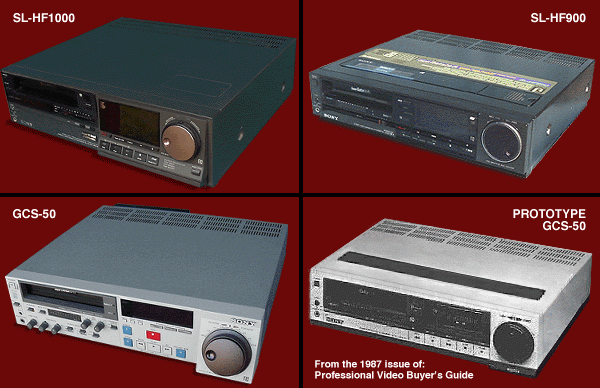
the tuner, timer and other consumer features but it looks similar to the SL-HF900. What's your opinion? (Q#50)
A: Some of Sony's professional machines have an obvious shared design with the
consumer lines. The SL-420 is perhaps the model that is most closely related,
being very similar to the SL-2500, right down to having the same timer
and even accepting a changer. The SL0-340, SLO-1400, EDW-10, GCS-1 and others
also have obvious family ties with the consumer lines. The models SLO-1800, SLO-383
and SLO-300 are stand alone designs and have no home companions.
The GCS-50 is a cross breed with ties most closely related to the SL-HF900,
due to its similar frame components and board designs. Some of the printed circuit
boards even share the same numbers. The early promotional photos of the GCS-50
used an altered SL-HF900 as the picture model but the keyboard layout was changed
when it was put into production, in order to be more consistent with the professional
line button set up. It does have the flying erase heads and the same drum as the SL-HF1000
but I feel that comparing it to the SL-HF1000 is actually selling it short.
The GCS-50 has better picture control circuits and features a stronger editing
format than the SL-HF1000, which you would expect from a machine costing almost
three times the price and having no tuner or timer. Each unit was designed based
upon a projected marketing segment and they are outstanding examples of Betas
desirability. They will be missed when you can no longer find them. To see a
side by side comparison of these models click here
Q:
How do you arrive at the prices for the units you offer for sale? (Q#51)
A: If the item is new it is based upon a predetermined resale markup as reflected by the manufacturers
suggested retail price. Refurbished items are figured using the cost of the
item, the number available and the time consumed in their refurbishing. Repairs
are based upon materials cost and the man hours invested. Every item and repair
receives a warranty, unless otherwise stated, and most everything offered is unique
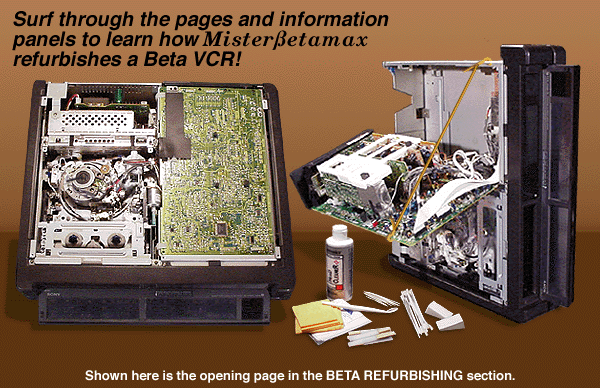
to the format. To learn more on how I refurbish a Beta click here
Q.
My Beta has a switch on the back that says 50-60 Hz cycles, what is is for and
what does it do? (Q#52)
A. The manual explains to set it for your country's house current cycles, which
is 60 cycles in the USA. Many Beta units were sold in various countries so the
frequency on these units was made to be adjustable. The clock/timer uses the
megaHertz frequency to keep time, set it wrong and the clock may run fast or
slow. To see a chart of the various nations house currents click here.
Q:
Can I get my Beta refurbished? (Q#53)
A: Refurbishing is a process reserved for the units that I offer exclusively through this Site. The time invested and repairs involved varies depending on the condition of the individual unit. (For more information on refurbishing click here.) I would be happy to recondition your Beta. This service features a procedure including parts and labor for returning it to top performance. These include, but are not limited to, evaluation and testing, internal cleaning, lubrication, replacing or renewing the upper video drum, replacing the pinch roller, and renewing the reels, guides, tension arm and tension band. The video drum grounding upgrade is also included, if it can be installed and the unit doesn't already have it. The prices vary depending on the model. (Discussion on methods and items mentioned is available in the "Beta Refurbishing" section.) To access the submission form for inquiring about reconditioning press the "Get it Repaired" navigator button at right. Be sure to explain the service you desire in the text area provided. You should receive a response within forty-eight hours. The warranty is the same as for a repair. (For a definition of terms click on the "Business Statement" link below.)
Q:
Do you repair VHS? (Q#54)
A: No. All of my parts inventory and expertise is concentrated on repairing
only Beta.
Q:
Is the Sony name an acronym for something? (Q#55)
A: The Sony logo is from the Latin word sonus (sound) and the English word sonny
(meaning my little son*). The company started life as Tokyo Tsushin Keenkyujo, or roughly
translated: Tokyo Telecommunications Research Institute. They changed their
name after they successfully introduced a small transistor radio to the U.S.A.
(and the world) called the Sony. The product became so famous, they renamed
the whole company. Now let's do the other Beta guys. Aiwa was founded in Japan
in 1951 as Aiko Denki Sangyo Co., Ltd., and from this the Aiwa brand name was
derived. In 1959, the company name was changed to Aiwa Co., Ltd. The name "Aiwa"
sounds like the Japanese words for "love" (ai) and "harmony" (wa). Around the
world, the Aiwa name stands for high quality products that are fun and easy
to use. In 2002 Sony acquired full ownership of Aiwa but still produces products
under their brand name. Sanyo was founded in 1947 as Sanyo Electric Works and
was a manufacturer of bicycle generator lamps. It soon moved into small appliances,
washing machines and radios. The name means three oceans based on the company
vision to market on a global scale. NEC or Nippon Electric Company, Ltd. was
established in 1899 in partnership with the Western Electric Company of the
United States to become the first Japanese joint venture with foreign capital.
Primary initial manufacture was telephones and switching systems. Toshiba was
formed from the merging of two older companies. Tanaka Seizo-sho formed in 1875
(Tanaka Engineering Works), Japan's first manufacturer of telegraphic equipment
and Hakunetsu-sha and Co., Ltd. formed in 1890 and later named Tokyo Denki (Tokyo
Electric Co.)., Japan's first plant for electric incandescent lamps merged in
1899 to form Tokyo Shibaura Denki (Tokyo Shibaura Electric Co., Ltd.). The company
was soon well known as Toshiba, which became its official name in 1978.
*For an interesting footnote to the Sony name click here.
Q:
Is it true that the clock runs out on the SL-HF2100 in the year 2006? Can it
be reprogrammed to overcome this? (Q#56)
A: The SL-HF2100 clock/timer will not accept a date beyond December 31, 2005. The timer control IC of the VCR was designed this way by Sony and it cannot be altered or corrected. There is a way around this nuisance. Consult a perpetual calendar and pick a year that has the days of the week where you need them and then program the unit using that year. You can substitute 1995 for 2006 and you must use the RMT-2100A remote to set the clock. Why December 31, 2005? Because January 1, 2006 is the date that the US congress designated as to when all the television stations (in the USA) were required to switch over to HDTV and discontinue their standard broadcast service. What has actually happened? Regular broadcasting continues and HDTV is just now making inroads into the mainstream of broadcasting. To see a "by the years" substitution chart click
here.
Q:
In what years were the different models made and how many of each were sold? (Q#57)
A: I can provide you with the various models, their years of release and the
suggested list price but none of the manufacturers revealed their sales numbers.
To see the Betamax Timeline chart click here.
Q:
Does "Beta" signify the loading method? What does it mean?(Q#58)
A: When Akio Morita set Sony engineers to the task of developing a video recording
system with a cassette small enough to fit in ones pocket (roughly the size
of a paperback book) their first try was called "Alpha" after the Greek letter
"A". It worked well enough but had some major drawbacks that Sony eventually
decided were too significant to allow its release to the public. It was too
hard on the tape because it had to be distorted around the video drum to keep
it aligned. Fast forward and rewind required the tape to be wound back into
the cassette to prevent damage, an awkward and bothersome procedure. The cassette
was also too big and the picture wasn't up to Sony standards. As a result this
technology was discarded and later sold off to a small company called Japanese
Victor and eventually became VHS. Sony went on to developed another system,
loosely modeled after their already successful professional U-matic format.
It did possess the desired properties that Sony was looking for and because
it was the second technology it was named "Beta" after the Greek letter "B",
and we all know the rest of the story.
Q:
I record a lot of movies, some of which I save. Invariably I end up with a sizeable
length of time left over at the end of a tape. My question is how did the L-500,
L-750 and L-830 lengths come to be decided on and can I buy other lengths of
tape? (Q#59)
A: Let us get in the Wayback machine and travel back to when Beta was under
development. The recording of television programs was the emphasis behind the
machine, so it only followed that thirty and sixty minutes recording time in (the BxI speed) would be the norm.
Even though the Cartrivision system which existed just prior to Beta had offered
selling and renting movies, its failure seemed to send a message that recording
movies was not going to be a key factor in the feasibility of home video recording.
After the success of the first Betamax a company called Magnetic Video petitioned
Fox Studios for the rights to market movies on video. Fifty titles were offered
to test the waters. Sales were moderate a first but it was enough to spark what
would later become a revolution in how the world would view movies. Next came
the format war, the issue of recording time and things got dicey. Times were
increased by reducing the recording speed and now the same cassette tape lengths
yielded more time. The K-30 was renamed the L-250 and would record for one hour
in BxII, the K-60 became the L-500 with two hours. Soon would come the L-750
for three hours of recording and even a slower speed that would add another
50% of recording time. Even though the cost of a tape dropped considerably over
time it didn't seem to matter in the long run. The total allotted time per cassette
showed to be the deciding factor. As for movie running times Sony and other
tape manufacturers wound custom length cassettes for the duplication labs but
the lengths we are all familiar with became the consumer standards, with the
L-750 becoming the big seller. If you record movies for posterity then you are
always going to run into the problem with time left over or tapes of too short
of length. The average movie duration is 93 minutes, which means that two movies
in BxII will almost fit on one L-750 but you may have to give up the last of
the credits. You may never know who was the Gaffer or the Best Boy. I have L-370s
for sale that run 95 minutes which will cover this situation but the trouble
is that Hollywood doesn't make just movies that are 93 minutes long, that is an average.
So the only remedy would seem to be keeping a supply of L-370 tapes on hand
for movies of 95 minutes and less, L-500s for movies of 95 minutes to 2 hours.
Then use the L-750s for those over two hours. I also have available L-530 cassettes
to cover up to 135 minutes and L-625s for up to 155 minutes. All times here
are based upon recordings made in BxII (times will be longer if your doing BxIII).
Check the special lengths link in the "CASSETTES" section if you want more
information or click here.
Q:
Why does S-Video produce a better picture when dubbing from one machine to the other than just using the video in and out? (Q#60)
A: S-Video allows a better picture because less processing is taking place when transferring the video information from one machine to the other. To say it another way you are recording the from one to the other using less electronics to get in the way of the picture. To get a better look at what this means in terms of signal path and quality click here
Q:
You mention several times throughout your Site about static electricity. How big a problem is it? (Q#61)
A: It is something that must be considered in every aspect of electronics. On the sub-atomic level everything carries an electronic charge. It comes from the electrons moving around from one atom to another. It seems that they just donít stay married to the same atom and once a bunch of them get together they can start to wander, or they can can be picked up. They can even be bunched up in large quantities and held together temporarily. If a large enough quantity gathers up they begin to take on a strong potential to discharge to an opposite charge and will eventually make a jump for it. The spark on the door knob from your finger after you walk along a carpet is electrons gathered up on your body traveling to a mass (the knob) that has an opposite charge than you. Lightening is another example of static electricity, only on a much larger scale. Going back down to the size we are concerned with, as in related to electronics, it causes problems when it jumps around in a circuit and messes things up. The circuits inside of ICs (integrated circuits) are microscopic and operate at low voltages. They are not able to take the high volumes of electrons that static can contain and the force can fuse together or break the tiny components in their circuits, causing their destruction. To keep this from happening precautions must be taken when handling ICs and design engineers must build electronic gear so that static can be safely drained away and never gets to the potential where it could damage the delicate ICs. This is why you see devices, keypads and buttons with grounds straps leading to the case. This is to neutralize the static forces and keep surfaces in a safe, no-charge state.
Q:
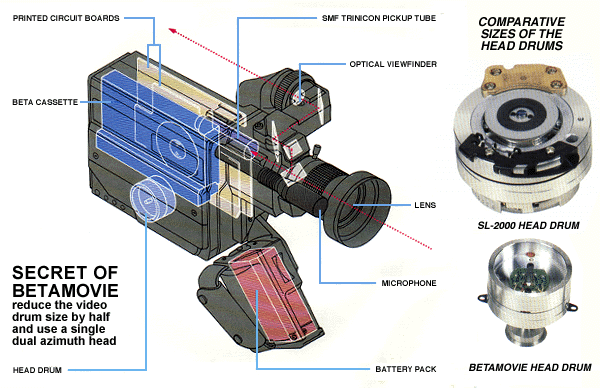
I noticed in your Refurbish section that playing an alignment tape is necessary to adjust a Beta VCR. If Betamovies only record, how do you adjust them? (Q#62)
A: The Betamovies require a special procedure alone with a special tool that allows them to be adjusted with an alignment tape. For more information click here
Q:
The L-830 cassettes seem easily damaged by scans in reverse and forward. What causes this and how can it be avoided? (Q#63)
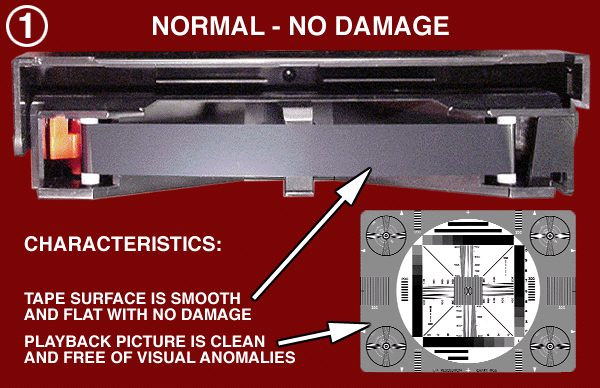
A: Ideally all recordings that you are going to be scanning or skipscanning should be made using the thicker grades of tape found in the L-500, L-370, L-250, etc. cassettes because it is stiffer and will be less affected by slight wear and misalignments of the tape path. When a Beta is new or refurbished the tape path components, and especially the rubber pinch roller, are in top condition and can handle the thinner grades of tape with little problem. During recording and playback the abrasive nature of the video tape removes the surfaces that it comes in contact with, which over time corrupts the path. Add to this the dirt that can build up plus the degrading of the pinch roller rubber from age and you can easily see how tape travel can become unstable or distorted. Because the thinner varieties of tape require a very precise alignment to maintain proper contact with the guides, they are the first to suffer when used in a Beta that needs an overhaul. The thinner tape base film can roll over or crease easier than the thicker base found in the shorter length cassettes. It is always a good idea to have any device that uses a physical process (like recording on tape) to be regularly serviced. Sony makes this very clear in their service manuals, however the message seldom gets out to the masses. How do you see this alignment damage so you know service is required? One sure way is to open the door on a cassette that is giving trouble and examine the top and bottom edges of the tape for curling or wrinkles. Sometimes creases can be seen running long ways down the tape. Both are definite signs of trouble. This kind of damage is not a failure of the tape. Extensive test have been performed and as long as the path is within factory specs these thinner tapes perform normally. Another way to spot trouble is to notice how the picture misbehaves during the playback and scans. To help you in spotting these problems I have composed a graphic, along with an explanation of what occurs on the screen during and after a tape damage event. To access it click here
One other thing I harp on, get a winder. Don't rewind in your machine, it will only shorten the life of you precious Beta and make repair required sooner.
Q:
What is micro timing-phase editing? (Q#64)
A: When Beta was young and recording was performed in the most simple of methods transitions between scenes was accomplished in one of two ways. The first option was for the tape to be stopped during the time the signal was not being recorded, to resume recording the function buttons were pressed. During the time interval the machine came to rest and all movement was halted. The second method was to activate a pause function, this put the machine in a standby mode with the video drum turning and the tape halted. Both of these types of "edits" (called crash edits) were very crude, and noticeable in the picture when it was played back. Evidence of the edit was displayed as picture tearing, flips or loss of sync. To correct this situation and provide clean, noise free edits the micro timing-phase system was developed. Special circuitry incorporated in various Beta models would reverse the tape slightly when record or record pause was requested before allowing forward movement of the tape. No signal was sent to the video or audio heads during this reverse movement. Once forward movement began a slight delay prior to actual recording allowed the electronics to try and match the signal coming in to the signal already present on the tape. If everything operated on schedule the transition from one scene to the next when played back showed almost no disturbance or phasing at the edit points. One of the reasons for the better performance of these edits was that the tape is already moving at the time when recording is introduced by the circuitry. This is a great improvement over a situation where the tape is starting up from a dead stop, as in the crash edit method. All of the above is assuming an off-the-air recording session. When dubbing from one machine to the other micro timing-phase is a great improvement over the crash edits but pre-roll and assemble editing offers the best situation. (Also see question below.)
Q:
What are pre-roll edits, insert edits, etc.? (Q#65)
A: Pre-roll, butt, assemble and pre-roll are terms used to describe particular
types of editing processes where various video scenes or segments are joined together
to complete a particular production. Insert editing is where a particular segment
is placed within a scene than has already been recorded and it is replacing the
information that is already on the tape. A little more detail please. First there
was crash edits. This is where the tape was stopped or paused to edit the incoming
material. It is messy because there is a noticeable break at the point of transition
from scene to scene. Butt edits are similar except the term is usually used to
describe a more sophisticated electro-mechanical method whereby the machine used
is capable of cleaning up the editing point. Found in the more modern units it
is the slight reversing of the tape prior to the point of edit, which helps to
overcome the inertial problems present when the tape moves from a dead stop (as
in the crash method mentioned above). Pre-roll and assemble editing is this last
step taken to a higher level and is usually used in dubbing material from one
machine to another. With assemble editing the desired points are programmed into
a master unit (either a compatible VCR or control console) that plays the desired
segments to be recorded onto the slave. After all the segments starting and ending
points have been entered the two machines are placed into a standby mode. Next
a start function is initiated and each segments is automatically called upon and
recorded to the slave as dictated by the controlling unit. Pre-roll adds increased
accuracy to produce cleaner edits. In this method the tape in each machine is
reversed slightly prior to the edit points and the recording is started while
both tapes are already traveling forward. A graphic may help make this last type
of edit easier to visualize, click here. Simple pre-roll edits are just using
the feature of the pre-roll when joining one scene with another. Cleaner edits
are accomplished this way but only two segments are being joined. Q:
Will
I be able to use my Beta when analog TV stops broadcasting? (Q#66)
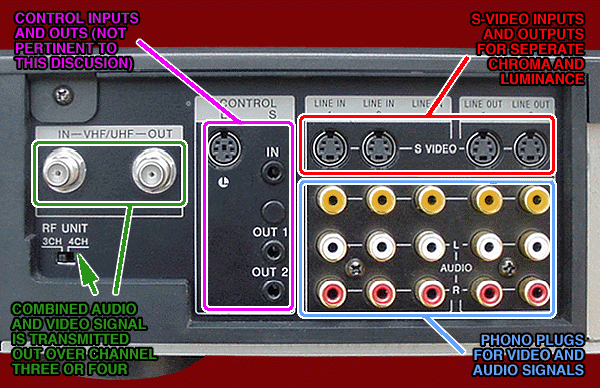
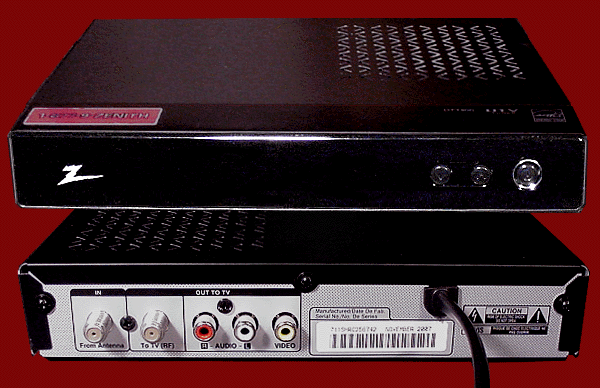
A: Yes. The adapter that converts the HDTV signal to analog has two outputs and one intput. It has RF 75 ohm coax in and out and composite
video with left and right stereo out. Your Beta can accept both types of outputs
and HDTV sets accept composite in (check your actual model to verify this
as it is not possible to know them all). To see the converter and the outputs click
here
Q:
What is edit preview? (Q#67)
A: Edit preview can mean several things but the most common is running through
and reviewing segments programmed into an editing console or machine prior to
actual assemble editing. This is done to make changes should an assembly error
be detected. Another is a special function available with many of the machines
that accept a camera. In this instance pressing a special function button while
the recorder is in the record-pause mode will cause the tape to reverse a short
distance and playback several seconds of the last recorded scene. The machine
will then resume the record-pause mode. Being able see the last several seconds
of the previous segment facilitates better continuity between scenes and not having
to change modes offers convenience.
Q:
What is a video frame (or field)?(Q#68)
A: It is one of the individual pictures (or fields) used to create or display a video picture. There are thirty of these in every second of the NTSC video signal. The term frame was carried over from the days of movie film when a single frame meant one individual picture or cell on a reel of movie film. For more definitions of audio, video and electronic terms check out this glossary by clicking here.
Q:
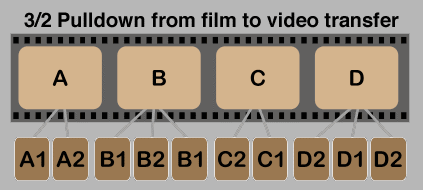
I have a large collection of 8mm films of my family that I would like to transfer to video and then to DVD. I have a telecine adapter but the recordings display an annoying flicker or rolling bar when played back. Why is this happening and how do I get rid of it?(Q#69)
A: The problem you describe is common and has to do with the frame rate difference
between film and video. To better understand why this happens lets look at how
motion is created before the human eye. When many single pictures are received
visually at a rate greater that roughly 18 frames per second the brain strings
them together so that minor changes in the content of the picture appear as motion
(the changes have to be incremental from one frame to the next). The more frames
per second the smoother is the motion. Motion picture film usually travels by
at twenty-four frames per second (because it syncs up nicely with the audio at
this speed). Thirty was chosen for television video (simplified version) because
it works well with the sixty cycles of AC house current and two frames fit perfectly
between each second in time. The difference does cause some problems when film
is transferred to video or vice versa. Direct transfer causes a strobe effect
that is generated by the difference in counts between frames. To overcome this
a special system that divides or multiplies each the frames by five is employed.
The system is called 3/2 pulldown (because of the rate of transfer), it is fairly
complicated and requires special equipment. It allows the segmented pictures or
video to be mathematically matched to a number common to both that removes the
strobe. Unfortunately tackling this problem is going to require using one of the
video companies that specializes is this transfer service. For a description of
the 3/2 pulldown process click here
For more information than you ever thought you needed about movies and transferring
film to video check out "How Film Is Transferred to Video" by clicking here
(opens in new browser window)
Q:
Which
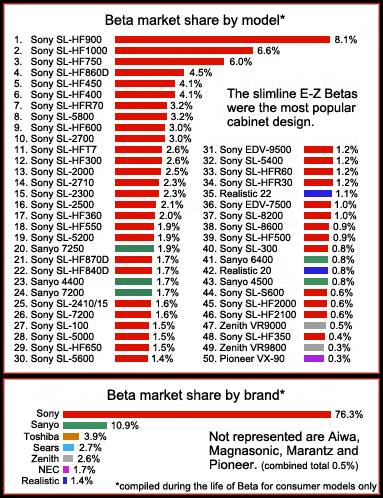
Beta models sold the best? (Q#70)
A: The Betamakers didn't release any figures regarding the number of model sold.
The best I can offer is a chart that was the result of a survey conducted in late
1989 by a video magazine. To see the chart click here
Q:
It seems to me that Beta VCRs are a little noisier than they need to be.
Is this my imagination or is it done on purpose?
(Q#71)
A: When the first VCRs came on the scene they were all noisy. Large motors, big solenoids and beefy levers made resounding snaps and pops when they operated. As VCRs improved through the years new innovations in design allowed for those mechanical components to become smaller and quieter. VCRs today can function with virtually no sound emanating from them. So, why then did the Beta units not become silent, or at least very quiet? While it's difficult to surmise why exactly, I do have a theory. The ability to hear the operation of a mechanical piece of equipment operating offers a verification that a function has or is actually taking place. I have several types of electromechanical units that are silent and not being able to tell when they are operating manifests an uncomfortable air of uncertainty or mystery. Front panel or on-screen displays also don't help take the away the ambiguity, they only verify that the displays are working. Perhaps the Betamakers felt that their consumers wanted to have the assurance that their units were actually doing something. It's only a theory, but as for me I like knowing when devices are operating. And yes, they are somewhat noisy.
Q:
My SL-HF840 has the picture frozen and it will not play any tapes. It records okay because tapes I record on it will play on my other Betas. What is going on? (Q#72)
A: Try forcing the digital circuits to reset by unplugging the unit and shorting
the blades of the 110 volt plug with a screwdriver. Wait about 30 seconds and
then plug it back in again. This action will reset the digital circuits. Turning
the VCR off with the power button won't be enough. It must be left unplugged for
a short while, shorting the blades insures the system is neutralized. This method
can solve a number of other problems too. Any time your Beta seems locked up or
behaves weird, like your channel indicator numbers seem scrambled or your clock
goes to all 8's, try resetting it. The primary cause is static electricity or
power surges. Static electricity is that shock you get when you walk across a
carpet on a dry day and touch something like a door knob. This burst of electricity
can confuse the digital circuits of the CPUs and ICs in your Beta. Fortunately,
this phenomenon occurs only rarely since manufactures design their units to handle
most stray static shocks. Resetting fixes most of these problems, itís like a
restart on your computer
Q:
I leave my SL-HF900 on most of the time and tune the stations for my TV through
the VCR. Does it harm it to leave it on all the time? (Q#73)
A: Leaving the SL-HF900 on all the time impacts it in several ways, how much depends on the mode setting of the VCR. When the SL-HF900 is turned on with no cassette in the machine the pinch solenoid is retracted and held, which readies the threading transmission for anticipated cassette insertion and loading. The solenoid closing can be recognized by the audible click when the power button is pressed. Leaving the VCR on in this standby mode consumes power, generates extra heat and shortens the life of the pinch solenoid. If you loaded in a cassette it would be better for the SL-HF900 because the solenoid comes to rest once loading has been performed. Turning it off would burden the electronics the least, short of unplugging it. One side note, the SL-HF900 is one of many units where the pinch solenoid closes when it is turned on without a cassette loaded inside. To tell if your model is one listen for the audible click when it is powered up on empty.
Q:
Do you really have a dog named Max? (Q#74)
A: Mad Max, the binary boxer, only lives in your computer.
Q:
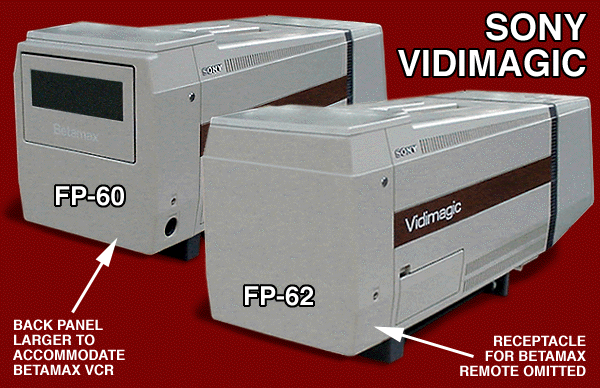
Was the Vidimagic, which combined a Betamax with a video projection system, the only model of it kind and how easy is it to operate? (Q#75)
A: I know of no other model than the Vidimagic FP-60 that combined
both, which certainly makes it very unique and desirable. Of special interest
is the projection section can be used independent of the VCR. The unit includes
a tuner with RF input (VHF/UHF antenna). Convergence problems common
with systems that use individual projection tubes for the three primary colors
of light are of no concern with the FP-60. It uses a single special
high energy single tube design that eliminates convergence, making it very easy
to set up when moved from place to place. It also is capable of producing a huge
picture. Sony also produced a less well known version of the Vidimagic that did
not include the Betamax, the FP-62. To see a side by side comparison
of the both units click here
Q:
What causes the white specks showing up in my picture from time to time, it seems
to be like some sort of static. (Q#76)
A: Since this is an intermittent problem Iíll rule out the Beta VCR as the culprit and say you probably have some kind of electrical disturbance taking place in your area. Spikes or electrical discharges are finding there way into your signal either from the AC line or they are being transmitted in the air from nearby. An AC line filter or noise suppressor can help if itís coming over the power line. Changing the antenna can help if it is airborne. The last resort is to try and locate the source and have it corrected by persuading the individual to responsible to act, hopefully in a positive way.
Q:
My recorder now only records in black and white instead of color, what has happened. (Q#77)
A: Because the signal reproduction is different for a black and white picture than it is for a color one the VCR (and television) has to make a distinction between the two. Circuitry within the unit has degraded to the point that it is out of adjustment or it has failed and all of the chroma (color) information is being killed or lost. This is a problem requiring a professional repair.
Q:
Which Beta was the best ever made? (Q#78)
A: I get this this question more than any other. In the past I have answered them on an individual basis but since there seems to be an increasing demand for my opinion on this subject I am going to risk publishing a list of "Beta's Best". I have put together a chart that you can access by clicking here. Please do not mistake this as an attempt on my part to set myself up as an authority, nothing is further from reality, this is only an opinion.
Q:
The numbers on my clock are flashing from left to right in a wave type fashion. What causes this and what can be done to correct it? (Q#79)
A: A capacitor is most likely failing and letting AC line pulses bleed into the fluorescent display. Sometimes it more noticeable after the unit has been left unplugged for awhile, being more visible at first then smoothing out slightly as the capacitor charges up. This requires a professional repair.
Q:
What does the model numbering mean? Is there a system, rhyme or reason for the stepped increases or the odd and even numbers? (Q#80)
A: It's difficult to pin down what the various model numbers and letters stand
for. Almost all electronics manufacturers engage in mild subterfuge when it comes
to model numbering. It makes better advertising copy and looks more prestigious
to list a model as XX1234 than it does as: Model 1, Model 2,
Model 3 etc. When it came to Beta it seems that NEC, Sanyo and Toshiba
did follow a loose pattern of increasing the number after the letter designations
with each successive model (example: Sanyo 4500, 4600, 4800....7150, 7200 or Toshiba
V-M41, V-M42 etc.). Sony on the other hand did some
fancy footwork with their numbers, but upon examination a loose pattern seems to emerge. The higher
end models usually did carry the larger numbers. Some examples: SL-10,
SL-20, SL-25, SL-30, SL-60,
and SL-90. The Hi-Fi models: SL-HF350, SL-HF450,
SL-HF550 and SL-HF650. With each step representing a
model with slightly more bells and whistles than the one before it, the highest
being the most featured and most expensive. You also have to take into consideration
the time period when the models were released. The SL-HF300, SL-HF400,
SL-HF500 and SL-HF600 are of earlier manufacture than
the Hi-Fi ones already mentioned and they do not fill in the spaces
between them. A similar situation exists with the Hi-Fi ready, digital,
ED Beta and the non-USA Beta units. Sony also released some wild
card models and sandwiched then between the sequential numbers, like the SL-HF360
SL-2710, SL-2405 and the SL-2001. And there
are other anomalies with no recognizable pattern, the: VCR 3, GCS-1,
GCS-50, SL-P44R, SLO-383 and SL-3030.
It is possible that all this numbering had some deep inner meaning but more than
likely it was just a way to promote various models and generate an impression
that each was different, special, slightly improved or higher in value than another.
Only the Betamakers know for sure. Q:
Why did Sanyo call their Beta VCRs Betacord or B-Cord? (Q#81)
A: Sanyo had some early entries into home video recording with a system they called
the V-cord, short for Video recorder. They produced several
models before joining forces with the Sony to produce Beta formatted machines.
Sony called, and owned, the name Betamax so they continued over into their models
their ěcordî suffix and added it to the ěBetaî format name. Beta was the system
name and was available for use by any licensed manufacturer. The new designation
"B-Cord" stood for Beta recorder. Q:
My Beta made a strange noise and had difficulty loading a tape, now it only turns
off and on. What happened and how can I get it running again? (Q#82)
A: A likely cause of the shutdown is an error occurred during the threading process.
To better see what may have happened click here
Q:
Can SuperBeta tapes be played on regular Beta machines? (Q#83)
A: Yes, but the higher luminance signal may cause some bursting in the light and
dark edges of the picture. It can be seen as white or black specks where there
is a bright to dark area and vice versa. Most times it is not too noticeable.
On the other hand, regular Beta tapes can play on SuperBeta machines with no problem.
Ed Beta tapes require an Ed Beta machine, but they will also play regular and
SuperBeta tapes. Q:
My SL-HF360 runs only in reverse. What is causing this? (Q#84)
A: The capstan in this model (and others) drives the reel assembly as well as pulls the tape through the tape path. To provide reverse scan and rewind the CPU sends a voltage to the capstan motor IC to pulse the pancake electromagnets in the the opposite direction. Your motor most likely has a short that is allowing current to leak over to the reverse circuit, or (less likely) the CPU is bad. This is a problem requiring service.
Q:
What does the drop-out circuit do? (Q#85)
A: The DOC (drop-out circuit) replaces missing information in the recorded signal
and is necessary due to the imperfections found in all video tape. Information
can be lost due to microscopic metal lumps on the tape, or a missing particles,
or any number of other anomalies. What the circuit did in it earliest design was
electronically take information from just ahead of where the drop-out occurred
and place it into the missing space. Visually, because the information was so
similar, you most likely wouldn't be unable to notice it happening. It was able
to do this magic because the signal coming out of the VCR is slightly delayed
from the real time tape playback. (If you want to see what drop-outs look like
play a well used tape in a machine with the PCM switch set to the on position.)
There is a limit as to how much correction can be done. A scratch or wrinkle on
a tape will come through, as well as other major defects. The latest model Beta
VCRs (EDV-9500, SL-HF2100, etc.) have digital processing circuits that can store
more information. They are capable of replacing entire scan lines with ones recorded
before it and drop-outs are almost never seen. (Note: turning the PCM switch to
the "on" position is actually turning the DOC circuitry off, see question below.)
Q:
My SL-2400 has a PCM switch in the back. I can't see much difference when I put
it in either position. The manual says leave it off except when using it for PCM
recording. What does it do? (Q#86)
A: The PCM switch appeared when Sony developed the PCM digital system for recording
sound onto video tape. Different from BetaHi-Fi, PCM uses most of the video area
of the tape to record the sound information. For more on PCM recording click here.
The purpose of the switch is to disable the drop-out
compensation circuit, called DOC, in the VCR so it will not interfere with the
playback of the PCM recorded digital signal. (The switch has no effect during
recording.) The DOC circuitry was improved in later design Betas so with the switch
was done away with. Also, improvements in tape manufacturing removed a lot of
the drop-out imperfection encountered in earlier tapes.
Q:
I recently purchased a Navco 2500 Beta VCR at auction but I can't get it to play
any of my tapes correctly. Is it defective? (Q#87)
A: Most likely not. The Navco 2500 will not properly play back tapes recorded
on other machines at the BII speed and it can't playback BIII at all. This is
because it is a time-lapse recorder that was designed and manufactured for surveillance
work. It uses the Beta format and tapes for recording but is not actually a Beta
recorder. It will record and play back in Beta II (called real time) but that
is not it's specialty. It's primary function is to record lots of video information
over long periods of time, and then play them back when necessary. A closer look
at this interesting application of the Beta format should answer a lot of questions.
To know more click here.
Q:
I have some tapes that are moldy inside. Can I still play them in my Betamax?
(Q#88)
A: Mold is a living organism that can float in the air and take root on almost
anything, provided a little moisture is present. One of the places it likes best
is where there is a good source of food, usually something organic that it can
digest. The plastics present in the Beta cassette (the shell, reels, film backing
and the adhesive binders) are organic polymers that make an excellent dinner for
a variety of enterprising mold types. Since the video tape binder and film is
the softest of the materials available, this is usually where it takes up residence.
Most often the mold is either white, dark blue-green or light brown in color.
Click here
to see several examples of cassettes under attack. Mold is a special plant with
a root system that penetrates the organic material and by using special enzymes
breaks it down into food that the plant can live on. The iron or chrome oxide
particles that hold the actual recording information are harder to digest so they
are usually left behind. If you attempt to play these tapes in this condition
there is a good chance that particles will come loose or the tape will separate
and remain inside your machine. So whether you attempt to play them is a matter
of degree of decomposition and importance. If the mold is very slight, the tapes
may play with no noticeable side effects. But if its bad you may coat the inside
of your unit with plant material, oxide and degraded tape film. How important
are the tapes you want to play and how bad do you want to see them? If it's a
one time thing and your dubbing them over to some good tapes, then it may be worth
it, but expect the picture to be degraded in quality. Also, be prepared to get
your Beta professionally cleaned when you complete you mission.
L
ike quizzes? Take the
"Ask
Misterßetamax"
trivia quiz. Test your knowledge of the Beta format and this Website. Are you
up to the challenge? To get started click here.